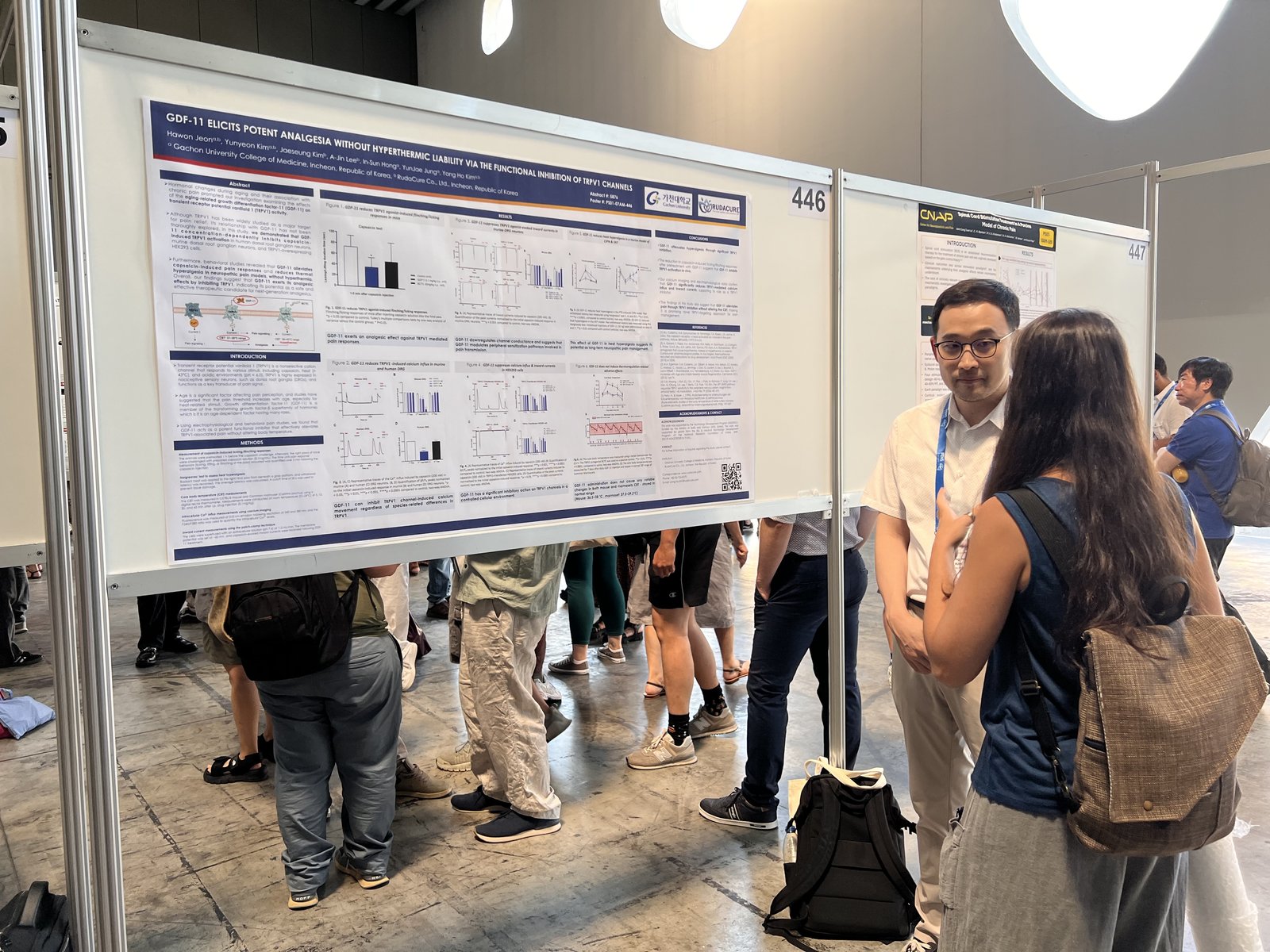
[Incheon] Drug developer RudaCure and a joint research team from Gachon University College of Medicine presented, at the European neuroscience forum (FENS Forum 2026) held on July 7 (local time) in Barcelona, Spain, findings on a novel analgesic mechanism that does not cause the fever (hyperthermia) side effect — long the greatest hurdle in developing pain therapeutics.
The team demonstrated that Growth Differentiation Factor-11 (GDF-11), which increases with aging, concentration-dependently inhibits TRPV1 — a core target of pain signaling — producing potent analgesia without altering body temperature. The work was accepted as abstract No. 5876 and poster No. PS01-07AM-446.
Background — why TRPV1, and why it has failed
TRPV1 is a non-selective cation channel that responds to capsaicin, heat above 43°C, and acidic environments (pH < 6.0), and is abundantly expressed in the sensory neurons (dorsal root ganglia, DRG) that detect pain, making it a representative pain target. Although it has long been studied as a potent analgesic target, existing TRPV1 antagonists also interfered with thermoregulation, causing hyperthermia — a side effect that proved a decisive obstacle to the clinical development of several candidates.
Focusing on the fact that “pain thresholds change with aging,” the team turned to the previously unexplored relationship between the aging-related factor GDF-11 (TGF-β superfamily) and TRPV1.
Key findings
- Target inhibition confirmed: GDF-11 concentration-dependently inhibited capsaicin-induced TRPV1 activity in human and mouse DRG neurons and in TRPV1-overexpressing HEK293 cells.
- Cellular and electrophysiological evidence: Calcium imaging showed reduced TRPV1-mediated calcium influx (F340/F380), and patch-clamp (−60 mV) experiments showed reduced capsaicin-evoked inward currents, supporting GDF-11 as a direct functional inhibitor.
- Analgesia in animals: In behavioral tests, capsaicin-induced pain responses (licking/flinching) decreased, and thermal hyperalgesia (Hargreaves' test) was alleviated in a neuropathic pain model.
- No fever (the key point): Core body temperature (CBT) measured in mice and marmosets (Callithrix jacchus) showed no change despite the analgesic effect.
Significance
This study shows that analgesia can be achieved while avoiding the thermal side effect that was the greatest obstacle to previous TRPV1 antagonist development, presenting a new direction for safe and effective next-generation analgesics.
Professor Yong Ho Kim (Gachon University College of Medicine · RudaCure), who led the team, said, “GDF-11 is an analgesic candidate with a novel mechanism that inhibits TRPV1 without affecting body temperature, showing the potential to overcome the safety barrier that previous pain therapeutics could not cross.”
The study was conducted by Hawon Jeon, Yunyeon Kim, Jaeseung Kim, In-Sun Hong, YunJae Jung, and Yong Ho Kim, with support from the Ministry of SMEs and Startups technology development program (00509031) and the National Research Foundation of Korea bio/medical technology development program (NRF-2021R1A5A2030333).
Presentation overview
| Conference | FENS Forum 2026 (European neuroscience forum, Barcelona) |
| Topic | Fever-free analgesia via functional inhibition of TRPV1 by GDF-11 |
| Date | July 7, 2026 |
| Poster No. | PS01-07AM-446 (Session 1, morning) |
| Author discussion | 11:30 – 13:00 (poster on display 09:30 – 13:00) |
| Abstract No. | 5876 |
RudaCure Co., Ltd. is an Incheon-based drug developer building a pipeline of new drugs addressing unmet medical needs, including TRPV1 pain therapeutics.
[Data provenance] The GDF-11/TRPV1 inhibition data cited here were generated by Professor Yong Ho Kim’s team at Gachon University.