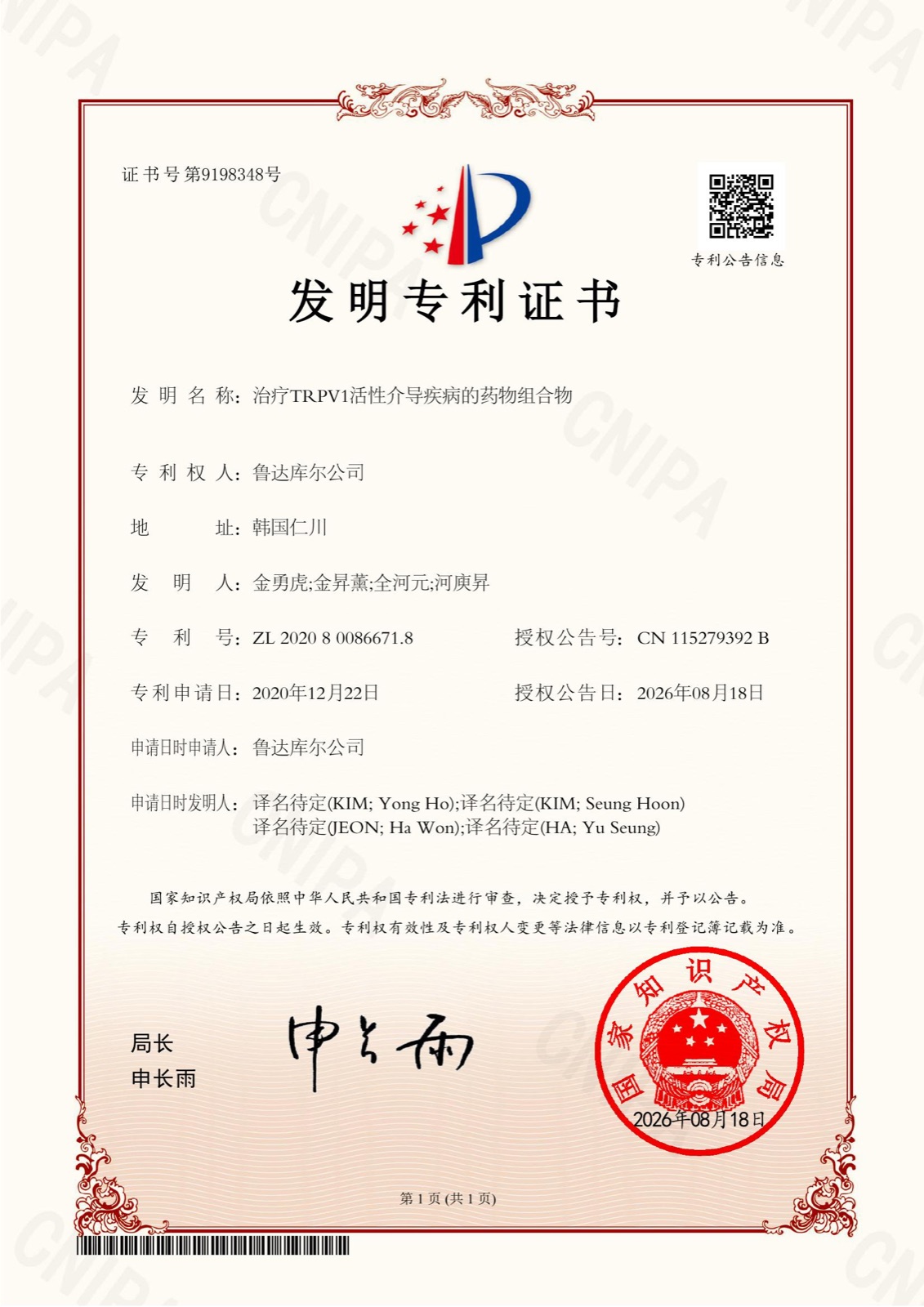
[Incheon] RudaCure (CEO Yong Ho Kim), a biotech company specializing in membrane protein and ion channel targeted drug discovery, has been granted an invention patent by the China National Intellectual Property Administration (CNIPA) for its technology treating TRPV1 activity-mediated diseases. The grant was announced on August 18, 2026 under issuance number CN 115279392 B.
The granted patent, "Pharmaceutical Composition for Treating TRPV1 Activity-Mediated Diseases," covers a pain therapy based on a growth differentiation factor 11 (GDF11) derived peptide together with the polynucleotide encoding it and expression vectors carrying it. With this grant, the family is now registered in three countries following Korea (No. 10-2339414, granted December 2021) and Japan (No. 7663882, granted April 2025). Examination remains pending in the United States and Europe.
Patent Summary
| Title of Invention | Pharmaceutical Composition for Treating TRPV1 Activity-Mediated Diseases |
| Patent Number | ZL 2020800866718 (Issuance No. CN 115279392 B) |
| Certificate Number | No. 9198348 |
| Application Number | 202080086671.8 (PCT/KR2020/018895, WO 2021/149925) |
| Priority Claim | 10-2020-0007433 (Republic of Korea, January 20, 2020) |
| Filing Date / Issuance Date | December 22, 2020 / August 18, 2026 |
| Patentee | RudaCure Corporation |
| Inventors | Yong Ho Kim, Seung Hoon Kim, Ha Won Jeon, Yu Seung Ha |
| Related Pipeline | RCI002 (TRPV1-targeting non-opioid analgesic) |
Granted Claims
Six claims were granted in medical use format. The independent claim covers the use of a pharmaceutical composition comprising the GDF11 peptide of SEQ ID NO: 1, the polynucleotide encoding it, or an expression vector containing it, in the manufacture of a medicament for treating TRPV1-mediated diseases. The specified indications are cancer pain, chemotherapy-induced pain, post-operative pain, diabetic neuropathic pain, migraine and joint pain. Dependent claims cover viral vectors including adeno-associated virus (AAV) as well as non-viral carriers such as nanoparticles, exosomes and liposomes.
Significance for the Chinese Market
China is the second largest pharmaceutical market in the world, with sustained growth in demand for chronic and cancer pain therapeutics. This grant secures exclusive rights to the medical use of the technology within China and establishes an intellectual property basis for future partnership and licensing discussions in the Greater China region.
▶ Download the official CNIPA Patent Certificate (PDF)
▶ Patent Certificate for Invention, English version (PDF)
[Correction notice · 15 September 2026] The mechanism of action described for RCI002 (RC-0165) in this article reflects the company's position at the time of publication. Naloxone was subsequently shown to fully block analgesia in the MIA osteoarthritis model, and the company has corrected the description: RCI002 is not a TRPV1-MOR dual-target non-opioid analgesic but a mu-opioid receptor (MOR) agonist administered by intra-articular injection. The current description is on the pipeline page.
[Data provenance] The earlier TRPV1 inhibition data for RC-0165 were generated by Professor Yong Ho Kim’s team at Gachon University.
[Data provenance] The GDF-11/TRPV1 inhibition data cited here were generated by Professor Yong Ho Kim’s team at Gachon University.